Thursday, July 16, 2009

Marina Abramovich Presents

Fascinating evening of performance art at the Whitworth last night. It was weird, first, to see the whole gallery empty of pictures, bare walls except for one room which had been scrawled on by one of the performance artists.

It started with The Drill, where Marina Abramovich give a speech about art then took us through a series of "excercises" that include looking someone straight in the eye, screaming loudly and walking out the room while paying attention to each movement. A good way of getting us to start paying attention of our own body processes and the world around, but being short sighted, looking in someone's eyes was difficult because all I saw was a blur!

The art itself was somewhat variable in quality. Things that didn't work for me included Melati Suryodarmo carrying a piece of glass around while saying "I love you." OK, maybe it's about the barriers we put up even when we say sweet words to each other. But it was a rather dull point, made dully. Similarly, jumping from the staircase onto a mountainous mound below while semi-naked (Amanda Coogan) didn't seem too deep to me.

But I do emphasise that this is something that may appeal to others, rather than me. Things that did work for me, however, included Ivan Civic's Back to Sarajevo, which involved projecting a film onto the wall while the artist climbed all over it, basically inserting himself into a film about a return to Sarajevo. I found it unaccountably beautiful. Similarly, Alastair MacLennan's piece, which involved carefully arranged shoes, all single shoes, no pairs; and also dry earth, pigs' heads, shredded paper, fish and chairs; with the artist himself sitting holding a bit of tree and a shoe on his head, was decidedly odd, but also strangely poetic. It seemed to me memorialising something, some past terrible deed; but it wasn't specific.

There was a little bit of nudity about, with Yingmie Duan exploring "dark desires" by walking very slowly and touching herself in a kind of mock-erotic way, and Kira O'Reilly falling very slowly down stairs, and making me think that if she slipped she could do herself an injury. These performance artists need a lot of discipline and control to do what they do; but I wasn't sure either piece had that much to say.

Nikhil Chopra was the only artist to use the gallery as his canvas, by acting the part of a fictional artist, drawing in charcoal on the walls, in a sometimes frenetic, sometimes meditative way. I liked that piece, not just because there was something happening, but because it had a sense of the primitive about it. In terms of control, Italian artist Marie Cool Fabio Balducci's piece was much cooler; but it seemed almost as if there was a barely concealed passion beneath the choreographed movements, making and unmaking of sculpure using mirrors, string, salt piles and other objects. The way she carefully lit a piece of cotton thread, that kept the flame at the same height as her hand moved down to meet it was mesmerising.

There was something mildly disturbing about seeing an artist's feet sticking out of a pile of rugs; but otherwise I think I missed the point of Jamie Isenstein's piece. Terence Koh lying about the gallery floor while music was playing similarly did nothing for me. But I liked Eunhye Hwang's The Road, which used radio static and her own body to make a curious kind of music. The noisiest piece, though, was Nico Vascallari's piece, in one of the stairwells, which involved him hitting metal on metal and causing the most amazing resonance and natural feedback effect I've ever heard. Although he was at the bottom of the stairs, some of the sound seemed to come from above.

The most disturbing and effective piece, however, was Fedor Pavlov-Andreevich's piece on the life and death of Vitaly Titov, in which he was completely encased in a wooden box, apart from a hole for his mout where members of the audience were asked to feed him, clean his teeth, even scrape his tongue. I took part in this, cleaning his tongue and it was the weirdest experience of the evening.

All in all, a good event and one I think I'll remember.

Tuesday, July 07, 2009

The State of British Poetry 1

Seems to me that anyone who's afraid that poetry in Britain has lost its way hasn't been travelling in the circles I've been travelling recently. Though I have been known to complain about especially performance poetry, my second trip to Arran confirmed that even that is in a reasonably happy state, with a new collection from Gerry Potter about to hit the stands (in fact, his first as Gerry rather than Chloe.) Performance poetry is often about story telling, and his stories from life in Liverpool are often highly colourful and moving, though in a rather traditional mode.

I met the poets from Unsung magazine in Arran, who had camped under the stars in Lamlash and got eaten alive by the English-hating midges, who managed to set up a reading in the Lamlash Bay Hotel on the Wednesday evening. A very lively reading ensued, and some great writing from all concerned.

But it's the post-avant side of Manchester poetry that interests me most. I really must get hold of Richard Barrett's latest publication (review copy, anyone?) and James Davies and Tom Jencks are both doing things that both puzzle me and intrigue me. Matt Dalby's sound poetry performance at The Other Room was also wonderful, if at times rather hard on the ears.

In fact, throughout the country, there's a host of weird and wonderful experimental things going on. Tom Chiver's selection of London poets for penned in the margin, City State, has loads of new young poets, many of whom are playing with the edges of what poetry is, mixing up the mainstream with the nonmainstream, the performance with the post-avant, etc...

But all this goes on under any kind of radar. The BBC Poetry Season had Tom Chivers on Late Review, but that was it. If you read the Guardian Review, you'd think all poets were published by Faber and Bloodaxe and there weren't very many of them. In fact, there's loads, and a lot of it adventurous and exploratory in ways that I don't understand sometimes, but I'd rather poetry went to new places than stayed in the same places all the time. Long live British poetry!

Labels: , , ,

Tuesday, June 02, 2009

Buy Salt!

If you haven't already, go and buy some Salt books.

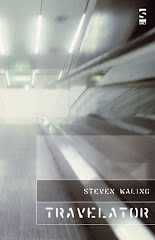
There's my own, of course, Travelator, for those who haven't already got it.

Then there's the work of Chris MacCabe, with The Hutton Enquiry and the new Zeppellins.

Ghost & Other is a great book from Geraldine Monk.

Jane Holland's two books are well-worth reading.

Tony Lopez is great.

Help to save one of the best publishers in the country.

Go to http://www.saltpublishing.com/ now!

Oh, and, News Just IN! A Third off all Salt Books throughout June!

Friday, May 15, 2009

Text Festival & Philip Davenport's About Everything

The second Bury Text Festival is well underway, with an interesting exhibition that at the Art Gallery. I went to the reading for the Bury Poems, where Philip Davenport read from his spell-binding new long poem About Everything, which mixes news reportage with photograph in a dazzling display of collage poetry. In many ways, it's a marvelously polyvalent poem, which can be read in several different ways, so that meanings shift and slide like continental plates underfoot.

But if I have a cavil, it is that it seems a little cold and distant at times; and perhaps reflects a bias towards minimalism in the festival itself. The works are all good, technically polished pieces; and I enjoyed the exhibition. But it rather lacked a little "wildness." Actually, my favourite piece that I say that day was Stuart Pickard's neon tube version of Darwin's Evolution tree sketch from his notebooks. I'm a sucker for anything Darwinian anyway.

I liked the way Philip's poems keep inserting a square box which, when he read from it, he read as nothing. As if all communication is miscommunication and everything amounts to nothing in the end. If there's a like of wildness in the poem, there's also an acceptance of that nothing.

The Bury poems reading was actually stunning. Geoff Huth and Matt Dalby have already blogged about it; but my personal favourite was the poems of Carol Watts. There, I think, is a poet who actually doesn't seem scared of emotions; the poem she read about her "Roy Orbison phobia", with its repeated references to American iconography, was spellbinding, as well as being properly challenging and "post-avant."

They all took themselves very seriously, though. It was lightened somewhat by Tony Lopez photographing the audience, but apart from that, they hardly cracked a smile. Do post-avants have to be so serious all the time? That's why I always prefered New York to Black Mountain or Objectivist: they didn't take themselves too seriously. Jokes are Ok in poems as well as philosophy, you know.

Saturday, May 09, 2009

The Luareate

Some of the reaction to Carol Anne Duffy's appointment I find rather puzzling. Aside from the sexist and homophobic Daily Mail comments, I read on Tony Trehy's blog that some avant garde poets were angry about it. Why I have no idea. Avant garde poets were hardly likely to be in line for it, and most of them think it's irrelevant, so why do they care?

Personally, I'm pleased for her, and if anyone can do the job, she can. If it means that poetry gets a little more attention in the next ten years, and she manages to promote it a little out of some of its self-imposed ghettos, then good. She's not the best woman poet in the country, not when Geraldine Monk, Wendy Mulford, Carol Watts and a host of us are around; but the post has never been about "the best"; and it's never been about the adventureous edge of poetry either. It's pure establishement; and that's Ok.

Mostly, I'm going to ignore it, as I did with Andrew Motion's tenure. I'll get on with life; it's not worse getting hot under the collar about.

Monday, March 23, 2009

Padel & Monk

A while since I've been here. I've been getting my head down, working at the prison and thinking of what I want to do next. More about that soon.

I've been going through a slow patch, writing wise, but finally things are coming again. I've just read two books of poetry from opposite sides of the poetic track. One is Ruth Padel's Darwin, which is basically a biography in verse. It uses her characteristic long, loping lines to good effect, and is actually very enjoyable, and sometimes moving, especially in the poems about his family. She inserts a lot of Darwin's writings into the poems; but this is no avant-garde cut'n'paste job; it all takes place in chronological order, it all makes sense, and doesn't do anything more than most mainstream poetry does. But it does it well. I enjoyed it a lot, actually. Though I wished it were more adventurous, that it played with our expectations more, that it surprised us with its form. But I guess you can't expect much more from a mainstream poet.

Geraldine Monk's Ghost & Other Sonnets is a much less mainstream affair that plays with the 14 line structure of the sonnet to create dense, rich sequences and connections that are much more the kind of thing I usually like to read these days. This is probably at first glance more approachable than some of her work, but it is in fact as intriguingly structured as any of her work. The sounds of some of these poems are often extraordinary; and picking one's way through the fractured narratives, glimpses of imagery and song and the juxtoposing registers of speech here can keep you rereading for hours.

It's good to see both of these collections. If I prefer one over the other, it would have to be the Monk. She seems to me to have a handle on how we experience reality in these days where even popular films like Pulp Fiction can interweave several narratives at once, can justapose time zones and themes with a kind of cut-up craziness that make your head spin. Ruth Padel seems stuck in the old chronological, hyptactic way of thinking; whereas everyone these days is getting used to thinking paratactically. It's how the internet reads the world, cyberrealism not realism.

The poetry of the future will be less tied to the old realism, methinks. But who knows? We might see a return to narrative...

Labels: , ,

Wednesday, February 04, 2009

Martin Stannard "Faith"

(Shadowtrain Books £8.95, http://www.shadowtrain.com/)

A new book from Martin Stannard is always an event for me. He's one of those poets whose voice - as cynical and world-weary as it often is - always seems fresh and open. He's probably one of the few poets in England who has genuinely brought that New York insouicient air of Romantic avant gardism successfully into English.

His poems are not difficult, but they do sometimes contain words like "happenstance" and "plangent". He's often funny, but he's ultimately serious about putting life's events into poetry in a way that takes them seriously, but doesn't over-inflate their important. He is, as the blurb on the back says, "keeping it real" but not in the usual way. There's none of the "look at me I'm working class" posturing you sometimes find in poets who want to tell you how they've suffered.

Well, Martin Stannard has suffered. So have I. So have we all. So get over yourself. His poetry about relationships reminds me at times of Jimmy Schuyler's approach to his madness, where, instead of Lowell's "I have suffered for my art, now it's your turn" schtick, we have "Jim the Jerk", going loopy but still able to laugh at himself. So the poems in the "Coral" section (previously published as a Leafe pamphlet) mock his own attempts to impress a girl with little bits of casually thrown in French words. It's easy French, and translated in the poem anyway, but does highlight the absurdity of the situation. He's serious about not being over-serious.

I've been a reader of Stannard's poetry since his pamphlet, The Flat of the Land, and he's published a lot since then. But there's also a lot still out there: some of it on the internet, some of it in obscure magazines all over the place. One day, his Ouervres Completes (Complete Works)will be so enormous that it will fill several shelves of volumes. And all of it will be full of an energy, a drive, charm and lyrical verve that very few poets in England have managed.

I can't tell whether this is as good as his last book, and I'm not sure I care. This is Martin Stannard, and he's better than most and a lot better than many. This book lives up to its title poem: it shows a profound "faith in poetry"; a belief that "The best poetry is of its time/ Or marginally ahead of it."

Labels: